
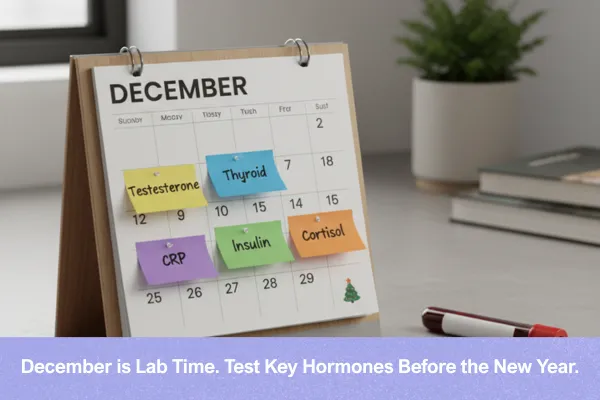
December Hormone Checklist: Optimize Health Before 2026
Between gift shopping and back to back parties, December rarely feels like the moment to tackle preventive health, but it’s actually the smartest month to do so. A quick hormone snapshot taken now does three things at once:
Reveals how a year’s worth of stress, diet, and sleep choices have shaped your biology.
Gives you a rock-solid baseline before you start January resolutions.
Allows enough runway to correct issues before spring energy and fitness plans kick in.
Below you’ll find five lab panels that deliver the most actionable data for both men and women, plus detailed lifestyle and clinical strategies from The Novus Center that turn numbers into real world results.
1. Comprehensive Sex Hormone Panel
Many people assume testosterone, estrogen, and progesterone shift only gradually; in reality they are highly responsive to sleep debt, refined-sugar binges, and even a single week of excess alcohol. Short winter days lower sunlight-driven luteinizing hormone, while year-end stress can suppress ovarian and testicular output. The result? Low libido, mood volatility, and stubborn belly fat that can appear seemingly overnight.
What to test
• Total and free testosterone
• Estradiol (E2)
• Progesterone (women)
• Sex Hormone Binding Globulin (SHBG)
• DHEA-S
Why it matters right now
• Men often see free T dip 10–15 % after just two weeks of poor sleep and heavy drinking. December in a nutshell.
• Women under forty can develop “relative estrogen dominance” when progesterone plummets from cortisol stress, driving PMS-like bloating and anxiety through the holidays.
Next step
Lab red flags qualify you for our Male Hormone Mastery or Female Hormone Mastery programs, where advanced diagnostics, bio-identical therapies, and peptide support restore balance quickly, often before Valentine’s Day.
2. Full Thyroid Panel (TSH, Free T3, Free T4, Reverse T3)
Your thyroid is the body’s thermostat. When temperatures drop and daylight shrinks, the gland naturally slows metabolism to conserve energy, a throwback to evolutionary scarcity. Add holiday comfort foods and skipped workouts, and sub-optimal thyroid function can accelerate fat gain and winter lethargy.
Key insights
• TSH alone can miss “subclinical” hypothyroidism. Free T3—the active hormone—must be assessed to know whether cells are actually receiving the metabolic signal.
• High reverse T3 is a stress marker; it blocks Free T3 at the receptor, explaining why some people feel cold and foggy even with a “normal” TSH.
Action plan
If Free T3 is on the low side, Novus clinicians combine selenium, zinc, and vitamin A with targeted desiccated thyroid or low dose liothyronine—plus light-therapy boxes that mimic sunrise and kick-start natural production.
3. Fasting Insulin and HbA1c
Gaining two or three holiday pounds often has less to do with calories and more with creeping insulin resistance. Glucose spikes tell the pancreas to pump out insulin; chronically high insulin locks fat inside your cells and sabotages hormone conversion (T4→T3, cholesterol→sex hormones).
Why both tests?
• HbA1c reveals the 90-day average of blood sugar, great for long-term view.
• Fasting insulin shows early compensation; levels above 8 µIU/mL mean your pancreas is already working overtime, even if glucose still looks normal.
Fixes that work
Adopt a protein-fiber-fat (P-F-F) template—½ plate lean protein, ¼ high-volume veggies, ¼ healthy fats or slow carbs.
Incorporate two 20 minute post-meal walks per day; muscle contractions immediately sponge up circulating glucose, dropping insulin as much as 30 %.
Consider inositol powder at night (2 g) to enhance insulin receptor sensitivity—particularly helpful for women with PCOS tendencies.
4. High Sensitivity C-Reactive Protein (hs-CRP)
Inflammation is the silent saboteur of hormonal harmony. Elevated hs-CRP not only predicts cardiovascular risk; it also dampens Leydig-cell testosterone production and impairs ovarian aromatase balance.
Seasonal factors
• Excess omega-6 seed oil snacks, sugar cookies, and alcohol inflame the gut, which releases endotoxins that drive CRP skyward.
• Winter viral infections can transiently spike hs-CRP, another reason to know your baseline when you feel healthy.
Lowering the flame
Omega-3s (EPA/DHA 2 g/day), eight hours of sleep, and a weekly sauna session can cut hs-CRP nearly in half over 12 weeks. For stubborn cases, Novus physicians deploy peptide rotation—BPC-157 for gut repair and TB-500 for systemic recovery.
5. Cortisol (AM & PM)
Cortisol follows a diurnal curve: high at dawn to wake you, low at night to let melatonin rule. Holiday stress flips the script, leaving you wired at midnight and sluggish at sunrise.
Testing methods
• Two point saliva collection is simple and pinpoints whether the curve is “flattened” (low all day) or “inverted” (high at night).
• Pairing cortisol with DHEA gives an adrenal-reserve ratio; low DHEA with high cortisol is a hallmark of burnout.
Restoring rhythm
• Morning: 10 minutes of outdoor light plus 200 mg rhodiola to lift AM energy.
• Evening: 300 mg magnesium glycinate, blue-light blockers, and a 5-minute box-breathing drill to suppress PM cortisol.
• Severe inversions may benefit from Oxytocin and/or DSIP peptide prescribed by our clinicians to help restore this balance.
Turning Numbers Into Results, The Novus Edge
Data are only half the story. Once your labs return, our process unfolds in three phases:
Precision Mapping – We cross-reference symptoms, lifestyle, and goals with each biomarker to identify true causality, not just correlation.
Tailored Protocol – Solutions can include bio-identical hormones, peptides, nutraceutical stacks, Apex RF vascular rejuvenation, MorpheusV/FormaV pelvic optimization, or bespoke nutrition coaching.
Quarterly Re-tests & Coaching – Every 90 days we adjust dosages and habits, ensuring continuous momentum instead of January–February drop-off.
Lifestyle Levers That Amplify Your Lab Wins
A protocol is only as good as the habits that reinforce it:
• Sun Powered Mornings – Daylight within an hour of waking resets the suprachiasmatic nucleus, which orchestrates cortisol, thyroid, and sex-hormone pulses.
• Zone-2 Cardio + Strength – Two 45 minute easy cardio sessions boost mitochondrial density and insulin sensitivity, while three lifting sessions signal the endocrine system to preserve muscle and bone.
• Digital Sunset – Shutting screens at 9 p.m. shields melatonin; quality sleep is the cheapest hormone therapy on earth.
• Protein Forward Meals – Aim for 30 to 40 g protein per meal; amino acids are the blue-print for every hormone-producing enzyme in your body.
Smart Supplement Stack for December

Quick FAQ
Do holiday colds skew lab results?
Mild illness can elevate hs-CRP and cortisol. If you’re sick, wait a week after symptoms resolve to test.
How soon will I feel better once I start a protocol?
Energy and sleep often improve within 2–4 weeks. Body composition, libido, and cognitive gains typically emerge by weeks 8–12.
Can birth-control users test hormones?
Yes, but synthetic hormones raise SHBG and mask true estradiol/progesterone. We interpret labs accordingly and may add urine or saliva testing for clarity.
Conclusion
December downtime is prime for a proactive hormone audit. By running these five labs, tightening lifestyle levers, and partnering with The Novus Center, you’ll enter 2026 lighter, sharper, and hormonally aligned, long before the average person starts their resolutions.
Ready to secure your Holiday Hormone Snapshot? Book your consult today and step into the New Year several strides ahead.


